Dad's cooking with heat
Cast Iron vs. Carbon Steel
Cast Iron vs. Carbon Steel
5/5/20268 min read
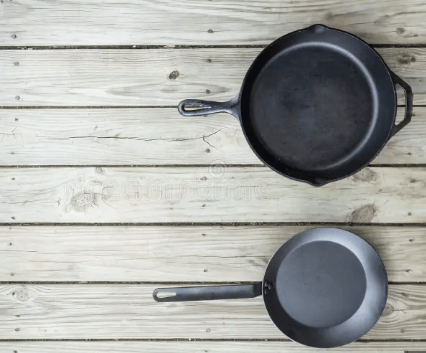
Let me tell you something nobody in the cookware world wants to admit: this debate is mostly fake.
Every article you'll find on "cast iron vs. carbon steel" is written by a brand trying to sell you one of them. Made In wants you to buy their carbon steel pan. Lodge wants you to stay loyal to cast iron. The content looks balanced — little comparison tables, careful hedging — but the conclusion is always conveniently pointed at whatever they're selling.
I don't have a pan to sell you. What I have is a decade of cooking on cast iron, 30 days of deliberately cooking the same meals on both surfaces back to back, and a strong opinion about which one actually belongs in a home kitchen — and when.
Here it is: cast iron is the better pan for most home cooks. Carbon steel is the better pan for most professional cooks. And the reason comes down to something almost nobody talks about.
Let's get into it.
First, The Science — Explained Simply
Both pans are made from iron. That's basically where the similarity ends.
Cast iron is roughly 98% iron and 2% carbon. The extra carbon sounds minor, but it makes iron brittle — which is why cast iron pans are made thick. They're poured into molds as liquid metal and allowed to solidify, which is what gives them that rough, pebbly surface and their substantial weight. A standard 12-inch Lodge skillet weighs 8 pounds.
Carbon steel flips the equation — it's 99% iron and just 1% carbon. Less carbon means more flexibility, so it can be hammered out into thin sheets and shaped into pans. The result is a lighter, smoother, more agile cooking surface. A comparable 12-inch carbon steel pan from Matfer Bourgeat weighs about 3.3 pounds.
Here's the counterintuitive fact that stops people cold when they hear it: cast iron has MORE carbon than carbon steel. The name is completely backward. Carbon steel, despite its name, is the lower-carbon material. People have been confused by this for decades and the cookware industry has never bothered to explain it clearly.
Now here's the property that actually matters in your kitchen:
Cast iron is a thermal battery. Carbon steel is a precision instrument.
Once cast iron gets hot, it stays hot. You could pull it off the burner and it will still be sizzling 10–15 minutes later. That mass stores energy and releases it slowly and evenly — which is exactly what you want for baking cornbread, searing a thick ribeye, or keeping a braise bubbling steadily for two hours.
Carbon steel does the opposite. It heats up in a fraction of the time and responds to temperature changes almost instantly. Drop the heat on a carbon steel pan and within 60 seconds the surface temperature has already dropped significantly. That responsiveness is what professional chefs need when they're cooking eggs to order, searing fish to the exact second, or tossing vegetables in a wok. The chef controls the heat. The pan obeys.
For a home cook who is likely cooking one thing at a time, taking their time, and not tossing food one-handed — that professional tool is often overkill.
The 5 Real-World Tests That Actually Matter
Test 1: The Steak
This is where cast iron wins so completely it's almost embarrassing.
The problem with searing a steak is thermal shock. When you put a cold, refrigerator-temperature piece of meat onto a hot pan, the surface temperature of that pan drops — sometimes dramatically. Carbon steel, with its thin walls and low thermal mass, loses 50–75°F instantly when a cold steak hits the surface. The sear suffers. You get steaming instead of searing until the pan recovers.
Cast iron barely notices. That 8-pound thermal battery absorbs the shock and keeps delivering consistent, ferocious heat to every inch of the meat. The crust you get on a steak in a cast iron skillet — that deep mahogany, crackly, restaurant-quality sear — is genuinely hard to replicate in anything else.
Winner: Cast iron. No contest.
Test 2: The Fried Egg
Here's where the conventional wisdom ("cast iron is non-stick once seasoned!") runs into reality.
A perfectly seasoned cast iron pan can absolutely cook eggs without sticking. But the margin for error is much smaller. You need the right temperature, enough fat, and patience. Get one of those wrong and you're scraping.
Carbon steel cooks eggs the way a professional omelet pan was designed to — which is exactly what it is. The smooth surface from sheet rolling creates a more even seasoning layer. The light weight lets you tilt and swirl the pan easily. The heat responsiveness lets you pull it back the instant things look too hot.
My honest experience across 30 days: eggs were easier, cleaner, and more consistent in the carbon steel pan every single time.
Winner: Carbon steel.
Test 3: Cornbread
Cast iron doesn't just win this test — it wins it in a category that doesn't even exist for carbon steel.
The thick walls of cast iron absorb heat from the oven and radiate it inward from every direction simultaneously. A cast iron skillet of cornbread gets that iconic crackling bottom crust because the pan itself has accumulated so much heat before the batter even goes in. You preheat the skillet in the oven, pour in the batter — it sizzles immediately — and slide it back in.
Carbon steel isn't designed for this. It's too thin, too light, and cools too quickly. You can bake in it, but you won't get anywhere near the result.
Winner: Cast iron. It's not even close.
Test 4: Fish
Fish is the great revealer of a pan's non-stick ability — and its weight.
Delicate fish fillets need gentle heat, careful temperature control, and the ability to slide a spatula underneath them without the pan fighting you. Carbon steel excels here. The pan is light enough to tilt easily, the seasoned surface is smooth, and the responsive heat lets you back off the moment the fillet starts to look like it might dry out.
Cooking salmon in cast iron is possible — good cast iron cooks do it all the time. But the heavy pan is harder to maneuver, the rough surface is less forgiving, and any temperature misstep is harder to recover from.
Winner: Carbon steel.
Test 5: Camping and Outdoor Cooking
This one surprised me.
I expected cast iron to dominate outdoor cooking — it's rugged, virtually indestructible, and made for campfires. And it does perform beautifully over open flame for things like bacon, pancakes, and anything you'd cook low and slow.
But for backpacking or any situation where you're carrying the pan any distance — cast iron is a non-starter. Eight pounds of skillet in a pack is a commitment most people aren't making.
Carbon steel is what serious camp cooks and overlanders are quietly switching to. Lighter, faster heating over variable flame, and just as durable over time.
Winner: Depends on your setup. Base camping — cast iron. Backpacking or vehicle-based camping — carbon steel.
The Argument Nobody Makes: Wrist Strength and Accessibility
I want to say something that the outdoor cookware industry is very reluctant to say, because it doesn't sell pans.
Cast iron is heavy. For many people — those with arthritis, wrist injuries, older adults, or anyone with limited upper body strength — an 8-pound skillet is not just inconvenient. It's genuinely painful to use. Moving a full 12-inch cast iron pan from the stovetop to the oven with one hand is something most people cannot safely do.
This is a real accessibility issue, and it matters. The cast iron community celebrates the weight as a virtue — "it's so solid!" — without acknowledging that for a significant portion of the cooking population, that virtue is a barrier.
If you or someone in your household has wrist, hand, or shoulder issues — carbon steel deserves serious consideration not as a compromise but as the genuinely better option for your situation.
A 12-inch carbon steel pan at 3.3 pounds is still a real pan. It still sears. It still seasons. It still lasts a lifetime. And you can actually pick it up and use it safely.
This is my strongest recommendation for anyone who has dismissed carbon steel as "the trendy option" without considering the practical reality of cooking with a pan you can comfortably lift.
The Price Reality Check
Let's talk money — because this is where most comparison articles suddenly go vague.
A quality Lodge 12-inch cast iron skillet costs around $35–$45 on Amazon. It is an outstanding pan. Lodge has been making cast iron in Tennessee since 1896 and there is essentially nothing wrong with their product. Buy it and cook on it for 50 years.
A quality carbon steel pan is a different story. The brands that serious cooks recommend — Matfer Bourgeat, De Buyer, Made In — start at $60 and go well past $100. The cheap carbon steel pans (under $40) are often made with thinner gauge steel that warps under high heat, which defeats the entire purpose.
My honest take: if budget is any kind of concern, buy cast iron. A $40 Lodge skillet will outperform a $45 no-name carbon steel pan every day of the week, and it will outlast your grandchildren.
If you're a more advanced cook willing to invest in a tool you'll use for decades, a quality carbon steel pan is worth every dollar of the premium. But don't let anyone sell you a cheap carbon steel pan as a cast iron upgrade.
So Which One Should You Actually Buy?
Here's my decision tree — the honest version:
Buy cast iron if:
You bake in your pan (cornbread, skillet desserts, frittatas, pizza)
You cook steaks, chops, or anything that benefits from a ferocious sear
Budget is a consideration
You cook mostly low and slow or oven-based dishes
You want something with zero learning curve on technique
Buy carbon steel if:
You cook eggs, fish, or other delicate proteins daily
You have wrist or hand issues that make heavy pans difficult
You want a lighter pan for stovetop work specifically
You already own a good cast iron skillet and want to round out your collection
You're an advanced cook who actively manages heat as a cooking variable
Buy both if:
You're a serious home cook who bakes AND does high-precision stovetop work
You want to cook the way professional kitchens do
You've already maxed out your cast iron skills and want a new challenge
My Actual Kitchen Setup (And What I Recommend to Everyone)
Here's the truth about my own pans after 30 days of comparative testing:
My go-to for 80% of cooking is still a 10-inch Lodge cast iron skillet that I've been building seasoning on for seven years. It's basically black glass at this point. It goes in the oven, on the stovetop, and occasionally over a campfire. It has never let me down on a steak.
The carbon steel pan I tested genuinely impressed me for eggs and fish. If I were starting from scratch today, I would probably own both — the Lodge for everything oven-related and heavy-duty searing, and a mid-range De Buyer carbon steel for everyday stovetop cooking.
But if you make me choose one? Cast iron. Every time. Not because it's objectively superior in every category — it isn't. But because it rewards patience, builds character as a cooking surface over years of use, and produces results that can genuinely stop dinner guests mid-bite.
That's not something I've ever experienced from a carbon steel pan. And I've been cooking long enough
to know the difference.
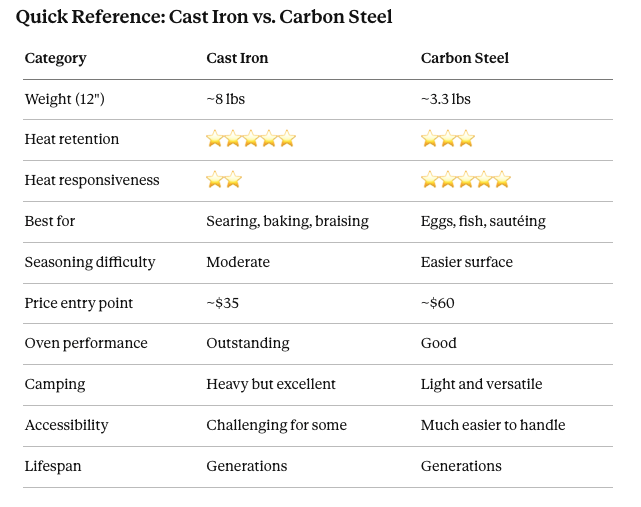
Quick Reference: Cast Iron vs. Carbon Steel
The Brands Worth Knowing
Cast Iron:
Lodge — The American standard. Outstanding quality at an unbeatable price. Start here.
Field Company — Lighter, smoother, more refined. Premium price but exceptional performance.
Lancaster Cast Iron —
Le Creuset (enameled) — Not the same as bare cast iron, but worth knowing. No seasoning required, acid-safe.
Carbon Steel:
Matfer Bourgeat — What French professional kitchens use. Heavy gauge, excellent quality.
De Buyer — French-made, excellent seasoning surface, mid-to-premium price.
Made In — American brand with strong marketing and genuine quality.
Avoid: Generic Amazon brands under $40. They warp. Every time.
The bottom line: Both pans are extraordinary tools that will outlast you. The "right" answer is whichever one you'll actually cook on — because a seasoned, well-used skillet of either type will beat every non-stick pan in the world.
Contact
Questions? Reach out anytime—we’re here.
hello@dadscookwithheat.com
© 2026. All rights reserved.